Wednesday, March 6, 2013

Buddhism in Myanmar Part 2: Syncretism

March 6th, 2013
Kuala Lumpur, Malaysia
Song of the Day: Fast Car, Tracy Chapman cover by Boyce Avenue ft. Kina Grannis
Mood: Exhausted

Nat worship
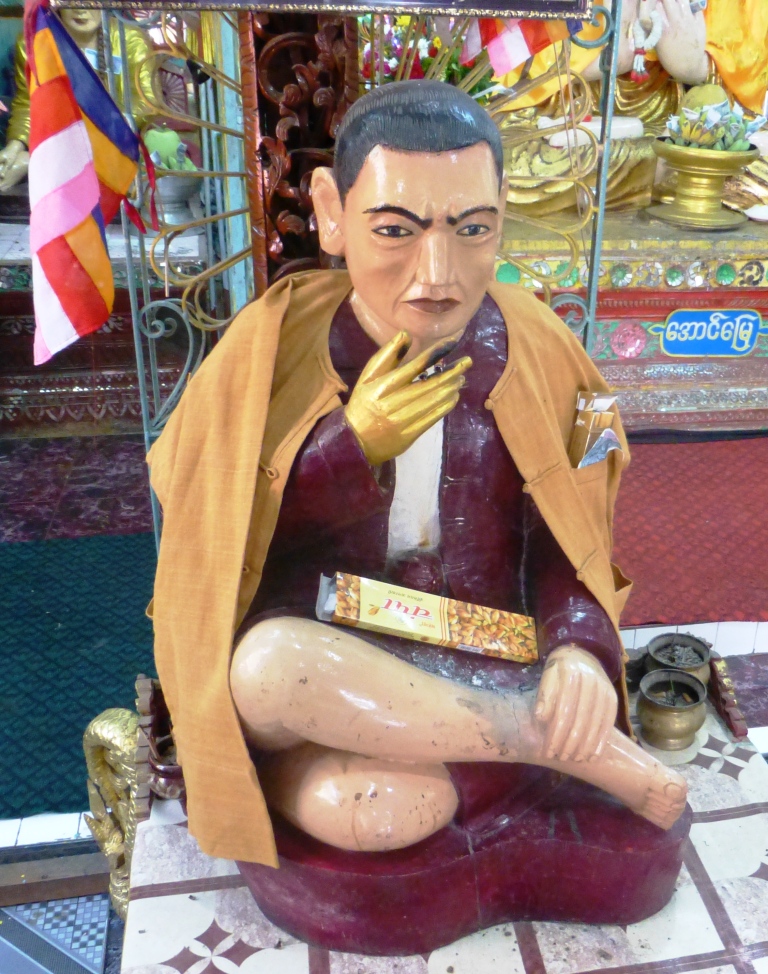
In Myanmar, nat worship preceded Buddhism. People believe that the world is full of spiritual beings called nats. The bad nats are believed to be humans that died terrible deaths and now cause mischief. People often leave food out in the back of their houses to placate them.


Nat (Botataung Pagoda)
Many armed woman (Mt. Popa)
I always knew mustaches were evil
(Mt. Popa)
There are also good nats that are guardians. These guardians are enshrined and worshipped so they will protect the people from the bad nats

Guardian nats (Bago)
Nat inscription (Bagan)
When Buddhism spread to Myanmar, nat worship was incorporated into the religion. In Myanmar, one will often find nats in pagodas.

Guardian nats surrounded by Buddhas
Nat house within pagoda walls (Botataung Pagoda)
As Myanmar developed, nat worship lost its role of significance in society. One consequence is that as people lost fear of the bad nats in the forest, logging and the harvesting natural resources began. Environmental protection advocates have had to shift tactics as people no longer fear the wrath of the tree guardians.
(Ava)
I would be scared if I saw these green nats from Mandalay or evil looking nats from Mt. Popa:


Buddha and the snake
In Yangon, a couple had a dream where a nat said that she had been turned into a giant snake and had come from far away to be with her brother. In the dream, the nat gave the couple a specific place to find her. When they awoke, they went to the place and found a Burmese python. 

They brought the snake to her "brother", a monk that lived in Bago.
The monk and the snake became fast friends
 and lived together until the monk passed away

At nearly 20 feet it is one of the largest pythons in captivity
People put money on it for merit
My hand against the body of the python

Initially, the monk lived in a small tent. Once the snake arrived, people started coming to visit and donating lots of money. Now there is a whole complex on the site.

Neon Buddha
In Myanmar, Buddha is often surrounded by a neon "halo"
Botataung pagoda
Neon nat (Mt. Popa)
Therefore, it makes more why churches here might incorporate neon lights on the podium
Myanmar map
Immanuel Baptist church, Yangon
Syncretism
Seeing how Buddhism was adapted to fit the Myanmar context makes me think about syncretism. As an outsider, it seems that if Buddhists want to help people reach enlightenment, tolerating nat worship in pagodas would confuse adherents and serve as a distraction at best. Combining nat worship and Buddhism seems like a marriage of convenience instead of a pursuit for truth. There is a very fine line between fitting your beliefs into a local culture and diluting your message to gain popularity and all leaders struggle to find the right balance.

The church in Myanmar has also adapted to try to fit the local context. For example, liberation theology is much more popular in seminaries here than in the U.S. because many people are oppressed and from war-torn areas and emphasize Jesus as a liberator. I hope that pastors and churches around the world can have wisdom and discernment to make God known to the people around them without sacrificing truth. When I try to talk about attributes of God and share stories about Jesus and my personal experience, I try to follow in the footsteps of the Biblical author Paul, such as when talking about the unknown God in Athens and being all things to all people for the sake of the gospel.

Monday, March 4, 2013

Buddhism in Myanmar: An Introduction and Part 1

March 4th, 2013
Kuala Lumpur, Malaysia (I'm catching up on my posts)
Song of the Day: We Are Young by fun. (ft. Janelle Monae) / the adapted version of Bubba Sparxx's 2006 top 10 hit with the lyrics, "Buddha, Buddha, Buddha, Buddha, Buddha everywhere"
Mood: Happy

Buddhism in Myanmar: Introduction to the Series
Buddhism is the most popular religion in Myanmar. About 89% of the population practices some form of Buddhism and nearly all young men spend a month or two at a monastery at some point. Myanmar is the most religious Buddhist country in terms of the proportion of monks in the population and proportion of income spent on religion. (Source: Wikipedia)

I have had almost no formal training on Buddhism and so all my thoughts represented here are from walking around many different pagodas in Myanmar and may not line up with the official Buddhist teaching and practice.

Part 1: Buddhism, a brief introduction
A summary of Buddhism
The Botataung Pagoda in Yangon posted this summary of Buddhism:

Highlights include:
·         Forbearing patience is the highest moral practice.
·         Not to do evil, to cultivate merit, to purify one's mind

Buddha's appearance varies by country
The Chinese Buddha is fatter and jollier than the others:
From Mount Popa
The Indian style shows the Buddha smiling:
From Bagan. The Buddhas hand postures have different meanings
such as protection or a call to witness the Buddha's enlightenment
The Myanmar style shows the Buddha as more expressionless. The rest of the pictures here are in Myanmar style.

Buddhas vary by material
Most of the Buddhas in Myanmar are made of gold. In some places, people even add gold leaf on to the Buddha to earn merit 

This woman paid ~$1 US to add gold (Bagan)
So much gold has been added to the statue in  the Mahamuni Temple in Mandalay
that there is now a covering of gold six inches think, distorting the image
However, the Buddha can be made of other material, such as this marble Buddha from Ava, the ancient capital of Myanmar:
Marble Buddha, Ava
In China, the Buddha is often made of jade.

Housed in Pagodas
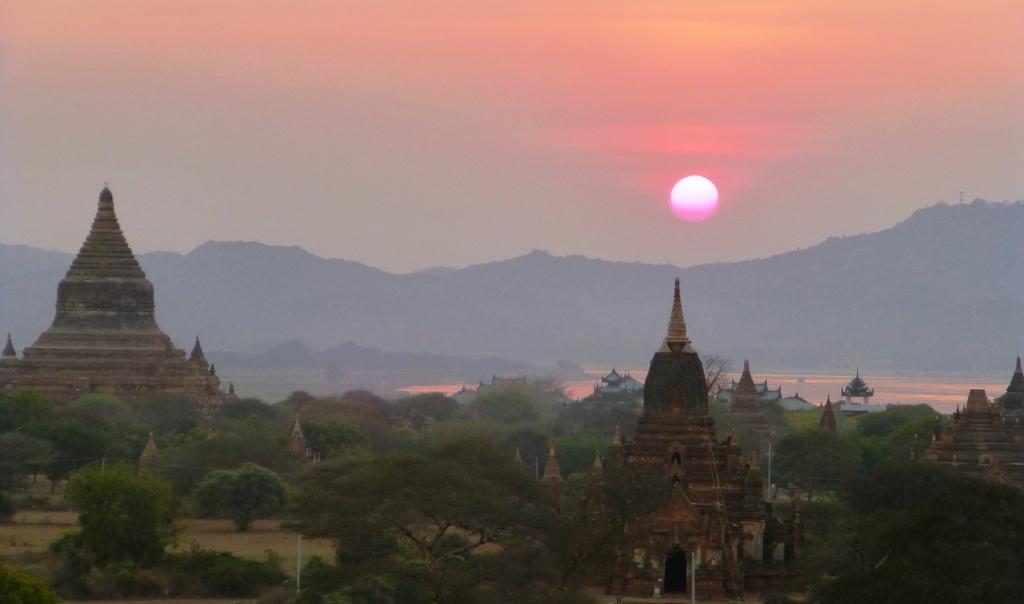
Worshipers build pagodas to house Buddha in order to earn merit. In some places such as Mandalay and Bagan, there are many, many pagodas near each other.
A sunset in Bagan, home of ancient pagodas
A sacred hill full of pagodas in Ava
The two largest pagodas in Myanmar are Shwedagon and Shwemadaw
Shwedagon pagoda in Yangon. It looks especially tall
from other parts of the city because it is on a hill
The Shwemawdaw pagoda in Bago is the tallest at nearly 375 feet.
For scale, all 6' 5" of me is in the blue shirt and khaki shorts.
The Kyaikpun pagoda shows four different images of the Buddha.
Each side is nearly 100 feet tall (Bago)


The Buddha is often placed in scenes relating to key events from his life
Siddhartha (aka the Gautama Buddha) is said to
have reached enlightenment under the Bodhi tree (Ava)
The story goes that while Buddha was deeply engrossed in meditation,
a giant snake rose up and provided share for him (Bago)
Reclining Buddha
In Myanmar, the Buddha is sometimes shown lying down.
Bago has the second largest reclining Buddha in Myanmar.
The Buddha is 180-feet long and was built over 1,000 years ago.
Botataung pagoda, Yangon
Buddha does not look like a typical human:
Buddha has long ears, possibly to signify great listening skills
or he is all hearing. (Bagan)
The Buddha is often given three lines on the neck
for beauty and auspiciousness (Bago)
The Buddha often looks very androgynous
Stay tuned to learn about how Buddhism is practiced in Myanmar...

Thursday, February 28, 2013

Healthcare in Yangon


March 1st, 2013
Yangon, Myanmar
Song of the Day: I Can't Help Myself (Sugar Pie Honey Bunch) by The Four Tops
Mood: Excited to start the next leg, sad to leave my family


Healthcare in Yangon
In the fall, I am starting at Wharton to earn an MBA with a special focus on healthcare management. I want to expand my knowledge base about healthcare delivery while I travel and a new friend, the Motherly Anesthesiologist (M.A.), generously connected me with hospitals and doctors in Yangon.

A hospital created to serve foreigners and well-off locals
The church clinic
Churches here deeply care about the needs of the community around them. The leaders of one of Yangon's churches determined the most pressing need for their community was access to affordable healthcare. As a result, M.A. and the Physiology Professor co-founded this clinic 10 years. Now, it treats 9,000 patients per year for an equivalent of ~$12,000.

Meeting the Physiology Professor and the Motherly Anesthesiologist 
These two amazing women started the clinic. At age 75+ they remain active in teaching and helping others. I hope to continue serving others with the same vigor when I am their age.

Even though the clinic is Christian, anyone in need is treated. Many people from different religious and ethnic backgrounds come from far away because they know that they will be treated with dignity, respect, and love.

When M.A. (in pink) found out I didn't have a cell phone,
she insisted I use hers until I left Myanmar
The clinic even treated one of the boys from the Professor's street kid ministry for free. They gave him a check-up, drove him to another doctor, took his x-rays, drove him back, gave him medicine, and scheduled a follow-up visit out of the goodness of their hearts.

At lunch after church
Compliance
In the US, patients not complying with medication prescriptions cost the healthcare system between $100 and $300 billion each year. (Source: Atlantic) Failing to comply can lead to a myriad of negative consequences such as increased drug resistance, hospitalizations, and risk of death.

We were able to see non-compliance firsthand. The boy said his medicine was stolen when he slept on the street instead of going back to the place we had rented for him and some of the other kids in the at-risk youth ministry. Even if he still had his medicine, not following the treatment protocol was a risk. Doctors say that many, many patients don't understand that they shouldn't take their entire course of treatment at once and the most important part of every appointment is explaining how to take pills.

The doctors were very clear that the boy's pain was a result of a lifestyle choice
and pain would continue unless he changed
Tuberculosis is relatively more prevalent here, especially among poor populations.
Luckily the doctors ruled TB out
The very night that we came back from the doctor, the boy made the same bad decision that caused his condition. The Professor asked the boy why he continued to do what brought him pain. He replied, "I don't know." When the Professor asked why it was bad, he responded, "Because it hurts my lungs and it makes my head funny." At least intellectually he understands the consequences of his actions. We can only hope that it will eventually lead him to change.

Pointing out the areas of lung damage 
It's impossible to help people that don't want to help themselves. It's also so hard to admit your own powerlessness when working with kids who might not have enough perspective to make good long-term decisions and especially those who are addicted to a substance. I agree with expert advice that if you're caring about others, your level of effort should match their effort, but it is still hard to wait patiently for people to want to change when you see the negative consequences.

The Anesthesiologist
The Anesthesiologist took me around to many different care sites. In addition to starting the clinic, she has had quite a remarkable life. The government used to pay for anesthesiologists to have fellowships abroad, and the Anesthesiologist was sponsored to study in the UK fifty years ago. Because her Western classmates were better prepared, she spent many, many hours studying to catch up and averaged only three hours of sleep per night. However, she succeeded and also studied at Stanford in the early '90s.


The government found that very few anesthesiologists would succeed like M.A. and stopped sponsoring anesthesiologists to study abroad. As a result, M.A. was one of less than a handful of foreign-trained anesthesiologists in the country for decades. 

In America, there are many more male doctors than female doctors and I wondered if it was hard for M.A. to be a doctor and get a scholarship as a woman in a patriarchal society. She said that it wasn't a problem in Myanmar and there is an even split between male and female doctors.

M.A. had trained nearly all the top doctors in Yangon. Everywhere we
went, she checked up on her former students and updated contact info
The woman in the middle is the head of the OR of one of the hospitals
we visited. M.A. has known her since she was a girl 
Searing loss
One of our stops was to visit M.A.'s friend after surgery. She is in early thirties and had her uterus removed two days before we saw her. She and her husband were childless and when I asked the husband how he was doing, he confessed how hard it was because now they would never be able to have children. In this culture, not having children is very stigmatized. It would be so hard to not be able to have kids if you really wanted them. The woman is a teacher and I think it would be doubly hard to work with children every day and not be able to have your own. I prayed for them at the end of the visit, and I hope that God can continue to comfort and encourage them in the days ahead.

Identity disguised to protect privacy

Making the rounds
M.A. connected me with one of the best neurologists in Yangon. He is so well known that when I was going through my pictures with a stranger at the Chinese embassy, he immediately recognized the doctor by name and I earned mad props for knowing him.

We were able to visit his clinic and see him in action:


Everyone has a unique sense of humor. This doctor loved his snow globe 
We were able to go on the rounds together:
For those who are wondering, he was wearing scrubs too,
but took them off before the picture.
"Sanitized" communal ICU slippers

Delivering care at the clinic

This girl could not be comforted
A busy day at the clinic's pharmacy
Cleaning up after oral surgery