Showing posts with label Awesome animals. Show all posts

Tuesday, May 28, 2013

Guilin part 3: Boat cruise to Yangshuo

May 28th, 2013
Chartres, France
Song of the Day: Ol' Man River by Kern and Hammerstein
Mood: Happy, healthy, and rested

Boat cruise from Guilin to Yangshuo
The most beautiful area of Guilin is viewed during a four hour boat cruise from Guilin to Yangshuo. The hills and mountains have been immortalized in Chinese calligraphy and have formed many westerners perception of China. The topography is rare and is the result of the erosion of limestone deposits.


In China, words are very important. If someone like an emperor or a chairman goes to a place and inscribes a word or short phrase, it is a big deal. Likewise, people love to quote short poems and use a choice phrase to accentuate a situation. I remember too few of the phrases I heard, but one in Guilin was, “Rain or shine, Guilin is the best!” To a foreigner, this doesn’t seem particularly poetic. However, I could tell I didn’t fully appreciate it as my guide had so much pride when he shared the poem as well as many others like it. I experienced Guilin in a light drizzle. It hurt visibility, but that made the place seem more magical and added to the mystique of the hills.


Boat convoy
Thousands of other tourists and I rode in a boat convoy down the river.


The water police conducted checks to make sure boats weren't over capacity
In stark contrast to our fleet, we passed by local transportation including taxis and fishermen in little boats.


Cormorants resting before their night fishing
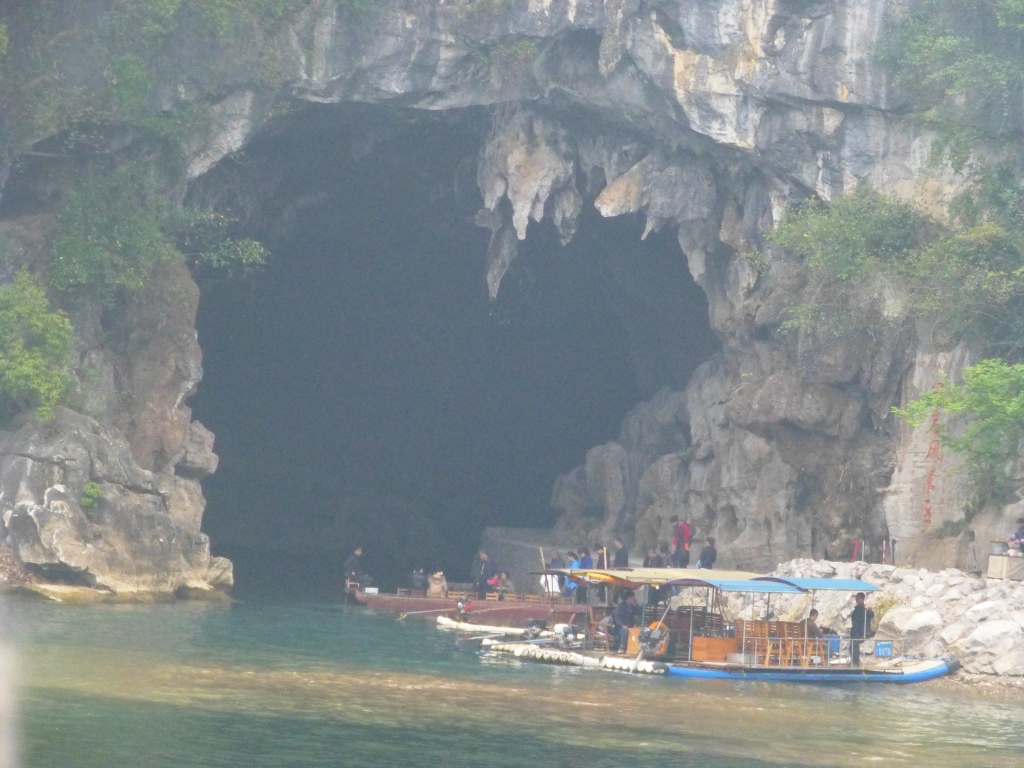
Nooks and crannies
If I were a pirate, I could hide my treasure in cave like this...
...but I'd probably pick a watery cave
20 yuan note site
Guilin’s natural wonder is captured on China’s 20 yuan note. We passed by the place that was the inspiration and I was impressed by how close the painting matched reality.


In my own little world
I decided to find a little place at the front of the ship and just stood for hours watching all the beautiful scenery go by. It is so hard to find time during normal life to pause and reflect and one of my favorite parts about nature is how conducive it is to contemplation. I also find that experience the beauty of the world like seeing these mountains or gazing at stars helps me connect with God and appreciate his creation.

I always thought that Ol' Man River was about a river.
It turns out Ol' Man River is actually a man that was on my boat.


Although Ol' Man River never left his post, you could go inside the boat
and warm up with a nice bottle of local snake wine
Nine horses mural hill
A famous geographic feature is the nine horses mural hill. I couldn't see most of them,
but you get bonus points if you can make them out.
 
Real animals


Is it possible to get more points for being an awesome boyfriend
than taking a girl out for a long horse ride on a beach?
Incentives
One of the reasons that I studied economics is that it does a great job understanding and predicting human nature. For instance, people notice that hundreds of thousands of tourists pass by the river each year. They have a lot of eyeballs and it wasn’t surprising that billboards have emerged in the least scenic spots.

 
They are still quite rare and I give the Chinese credit for doing a great job protecting the vast majority of the scenery and preserving the natural beauty.
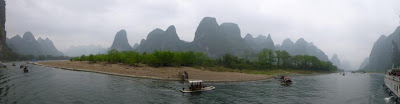
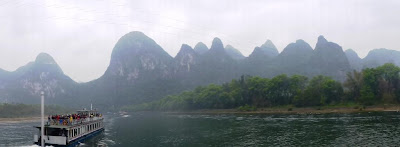
Panorama shots:


Wednesday, April 3, 2013

Caves

April 4th, 2013
Queenstown, New Zealand
Quotation of the Day: "I believe in Christianity as I believe that the sun has risen: not only because I see it, but because by it I see everything else." - C.S. Lewis

Caves
I have visited many caves during my odyssey. Each one is special in its own way. The Dark Cave at Batu Caves (Malaysia) provided an authentic experience and was my favorite cave. The Reed Flute Cave (China) represented human "improvements" to natural beauty. The Glowworm caves in Waitomo, New Zealand highlighted a cool cave animal.

Batu Caves, Malaysia
The Batu Caves were the best. Visitors are allowed to explore the Dark Caves with a guide. Our guide had a college degree in the field and was passionate about all the information.
Our guide ready to explore
The Dark Cave is home to two types of bats: the loud fruit bats, and the silent insect-eating bats. As we walked through the cave, it was crazy to think there were thousands of bats above our heads. As well, it is home to the rarest spider in the world, the trapdoor spider.

The most light inside the cave was at this, which was near the cave entrance
I liked this cave because it was unadulterated by humanity except for a small walking pathway. People used to be able to stroll in the cave and there is graffiti on a bench from the 1970s, but access has been highly restricted for decades. Now, there are no electrified lights in the cave. Each person carries a small flashlight ("torch" in the British colonies), but is not allowed to flash it above shoulder level so as not to scare the bats.

In a massive chamber in the middle of the cave, we stood in total silence. After we turned off our torches, we were blinded by the darkness. I tried to put my hand mere inches in front of my eyes, but it was useless. Without the light, I could see nothing. 

In addition to the bats, the caves are home to many awesome insects. Over the generations, they have adapted to the dark conditions by developing extra long legs, losing pigment, and losing their eyes. We were able to see many of these sweet creatures scurry by. Much of the cave is closed to the public so that researchers can come in and study the natural life.

There are lots of very cool rock formations caused by water rushing out of the cave.

Reed Flute Cave, Guilin, China
The Chinese cave went in a completely different direction. They took a beautiful rock formation and turned it into a spectacle. They were very good at what they did and I laughed at many points, but it was hard to fully appreciate it.

The cave is extraordinary in itself without any improvements. It has a rich history such as when it was used as an air raid shelter in World War II.

Some of the views were absolutely stunning. The natural beauty is augmented by multi-colored lights.
Here is how the cave looked in white light
Then colored lights are added:


There were many signs in the cave; however, they only talked about what the formations looked like (e.g. fruits, animals, etc.), instead of any useful information.

Every cave has a hollowed out area with the cave's tallest heights, which is called the cathedral. The cathedral in the Reed Flute Cave was breathtaking and incredible.
Just a small portion of the cathedral
The place is known for its reflection pool in the back. Many foreign dignitaries like former President Clinton have visited the cave.
This was definitely my favorite part
My guide claimed that the many figurines like this "lion" formed naturally.
Somehow I doubted that... I pushed him on it, and he admitted
there may have been some adjustments
The experience was like going to see a stupid comedy at the movie theater. I enjoyed it and laughed a little, but I almost always prefer learning over entertainment. The Batu Caves showed me how awesome a cave could be and the Reed Flute Cave simply showed me how creative humans can be.

Waitomo, New Zealand
My cousin and I went to the glowworm caves in Waitomo. The caves are interesting because they are home to glowworms. Scientifically speaking, they are actually a form of fly instead of worms. The lifespan of a glowworm is nine months long. In the first stage, it is an egg. Then it turns into a larva (or maggot), where it spends most of its life. It creates about 20 strings which it uses to catch food.
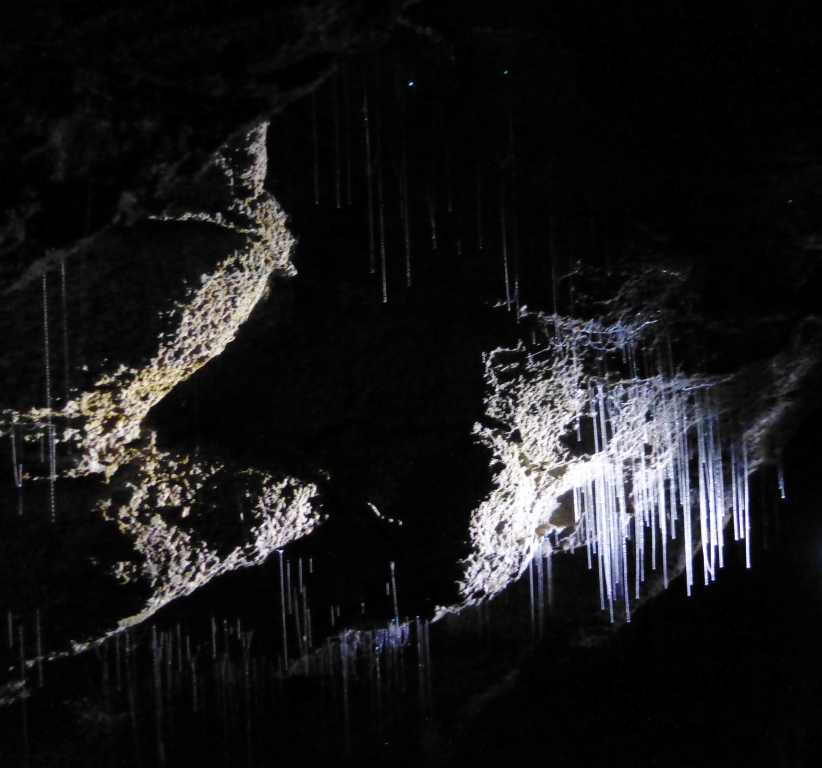
The string length depends on how much wind is in the area
They are invisible unless someone shines light upon them
To lure mosquitoes and other bugs into its traps, it converts food into a chemical reaction that emits lights for its tail. The bugs think that they are making their way outside and then get caught up in the trap and are eaten by the larva.
Each of the lights is the illuminated tail of a glow worm on the cave wall.
The larva eventually turn into pupa where they undergo a process in which their mouths become ineffective and their digestive system turns into a reproductive system. They hatch and copulate within the next two days and then die.

I enjoyed this cave because I learned about a cool animal, was able to see one close up, and then went on a mini-cruise through an underground river to see hundreds of glowworms.

In addition to the worms, the cave had some cool views.
This manmade view shows the dimly path to the bottom of the cave.
The low light helps people's eyes adjust to the darkness of the cave.
The path makes this cave wheelchair accessible, which is really cool.
On the right you can kind of see a curtain formation. It is really cool
when juxtaposed to the standard staglagtites and stalagmites
Cool stalagtites. Memory tool: Stalagtites hang on tight to the
ceiling, 'mites just might reach the tites some day. They grow
closer at a rate of nearly 1 cm every 100 years