Showing posts with label Transit. Show all posts

Monday, July 8, 2013

Transportation and Racism in Bangkok

Transportation
Bangkok has an ill-conceived public transportation system. It does not go to a lot of the places that people want to go. Sometimes they set up temporary stations, which are not designed for many people, but the planners don’t estimate demand well so not enough rails are built. One of the temporary stations is actually the busiest station in the system. However, if you have the fortune of being near a stop and your destination is on the line, the experience of riding the metro is enjoyable and the commercials they play on TVs in the cars are amusing.
Don't sit in the seat reserved for monks
A variety of motorbike taxis, taxis, and buses fill the gap and they are quite affordable for tourists. Buses come in many types and you can choose those with or without air conditioning. I was able to experience a variety of different means of transportation.

Motor taxis
The most exciting is the motorbike taxi. You jump on the back and hold on for dear life. One morning, the B.P. wanted to give me an authentic experience and hailed one for me.
Motor bikes! My driver went much slower than he does for locals.
Still, I worried that he wouldn't factor in how large my legs were
when we tried to pass by cars, but he faithfully steered us to safety
Buses
The B.P. has an amazing ability to quickly adapt to new environs. Within a couple months, he knew the bus system better than most locals who had lived in Bangkok for years. When I was stuck across town, I called him, told him where I was, and he knew all the different buses I could take to get to where I needed to go.

After our day at the school, we rode a bus to get to our next destination.
This is the kind of bus we rode
Sitting on the bus
Racism
Thailand was one of the most racist countries I visited. The treatment you receive depends on the color of your skin. Locals said that if your kid goes to a tournament, it doesn’t matter what place your child finishes. If they rank higher than a white child, it is seen as a big accomplishment. Thais are treated most poorly by other Thais.

At the Grand Palace, the guards profile you based on your skin color. Many Asians who know the Thai word for “Hello” can get in for free and walk by the guards without getting asked for any identification. All the white people are stopped.

Taxis
My skin color was bad for taxis. At the airport, people get completely gauged at the arrivals lounge, so I went to the departure area where locals normally get metered taxis. As a white person, none of the taxis would take me on the metered rate. After I was denied five times, I finally negotiated a rate that turned out to be multiples of the going rate. When I asked for change, the taxi driver tried to take a 33% tip on the inflated rate we agreed upon, even though tipping isn’t part of the culture.

Later on the street, my friend tried to hail a taxi. When taxi cabs stopped and saw me, they asked for a much higher price than it should have been. My friend protested in Thai and told the driver to drive off. Finally, the fourth driver said, "C'mon, he is a foreigner, he has a lot of money." He tried to get nearly five times the actual metered fare! As a result, I had to hide until we agreed upon rates with new drivers.
My disguise worked surprisingly well
Metro
But, my race gave me perks in the metro.
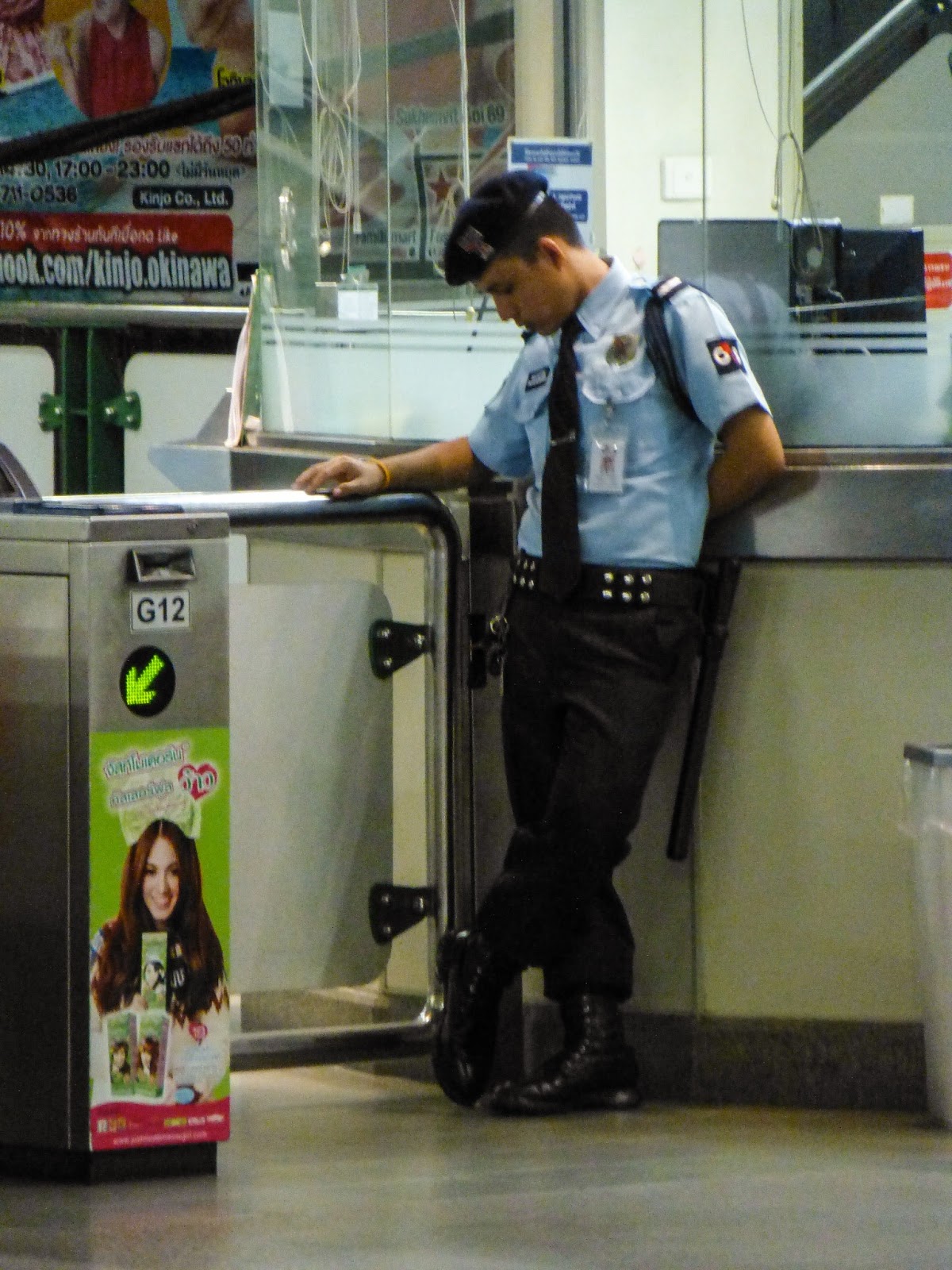
The guards would salute me and open up the special access point for me. I always liked to salute them back. My non-white friends did not receive similar treatment, even if they were foreigners. 

Receiving discriminatory pricing was frustrating and preferential treatment was awkward. It would be a lot simpler to live in a culture where you're not easily identifiable as “other” so that people interacted with you based on your personality instead of who they assumed you were. It made me not want to live in Thailand and have to put up with it on a daily basis.

Yet, I was able to understand why everyone did what they did. The guards only stopping white people because that is the most effective way. If they stopped everyone, it would cause long lines to develop. The taxi drivers know that white people have resources and don’t care about a few dollars difference in fare so they can improve their income by playing foreigners. The soldiers know that white people are typically richer so if they have a positive experience in Thailand, they will be more likely to invest, which will help their people. Everyone responded to incentives and reasonable expectations. Stereotypes are so hard to root out because they are most often grounded in fact. A lot of people get caught in the crossfire and compassionate people should strive to overcome their internal biases to work for a more just world where people are treated as individuals, but it is very difficult to change perceptions on a societal level if they are grounded in a general shared experience.

Wednesday, May 29, 2013

Guilin Part 4: On shore in Yangshuo

May 29th, 2013
Chartres, France
Song of the Day: Without You by David Guetta ft. Usher
Mood: Rested

Back on shore
Welcome to Yangshuo
Once you’ve arrived at Yangshuo, there are a few activities to do. As is the case anywhere, there is people watching and cultural appreciation among the tourist traps.

"We only sell good coffee, not sell STARBUCK coffee" ZING!
A rare diss at American premium products

If 3D is awesome, imagine how great 5D must be!

In the airport, there is the date in lunar and "normal" calendar formats


Who would ever buy this for their wedding? If a groom bought it as a gift, it could be
misinterpreted as a thinly veiled threat. Also, who wears a lip ring at their wedding?


No striting (and don't you forget it!)
Banyan Tree Park
There is a great Banyan Tree park nearby
Old banyan trees are amazing because they are so wide.
This is one massive tree
 
 This site was used in a love scene in an old famous Chinese movie Liusanjie. For the record, love did not blossom here for me.
 

 In addition to the big trees, there is even more gorgeous scenery.


Impression, Liu Sanjie - Massive ethnic dance performance
My favorite activity was going to an incredible show of hundreds of performers. The show is designed by Zhang Yimou, who was the choreographer of the Beijing Olympics. The theater claims to be the world's largest natural theater and is literally on the Li River.

Thousands of people come every night. Spotlights light up the hills in the distance.


Transportation
I loved all the different boat taxis there were:


Country house
As part of my Yangshuo experience, I went to the house of a family in a local village. They still live there and had preserved many parts of the house from several decades ago.

In America so much of the process is mechanized, but here I saw local
farmers that relied on their own strength
Their living room gave me a much better impression of how revered and respected Chairman Mao was.
 

The perception of Mao has changed over the last five years. The Chinese government once said that Mao was 70% right and 30% wrong. People used to focus on what he did right (e.g., military victory, women’s rights, infrastructure) and wrote off his failures. For instance, five years ago, a good Chinese friend generously treated me to dinner. When paying for the bill, he pulled out a 100 yuan note and pointed to Mao and simply said, “Great man. Great man” As a guest in a foreign culture, I wanted to be respectful and better understand, but I was flabbergasted as in the US, we hold Mao responsible for the deaths of tens of millions of people from starvation during the Great Leap Forward (he let his people starve while exporting food as aid to other countries). As well, his persecution and murder of intellectuals, as well as the destruction of historical artifacts, during the Cultural Revolution adds to his infamy.
Now the tides have turned. Throughout China, people openly criticize Mao and acknowledge his terrible deeds and feel a great sense of loss at his destruction of traditional Chinese culture. I am shocked at how complete the opinions have shifted in such a short time. It would be like people saying that Presidents Washington or Lincoln were actually terrible men. Perhaps some revisionist historian will find something that shifts public opinion, but that shift would take decades and not just a few years.
Bird keeping
Old men in this part of China love to train birds as pets. Some men keep them at home to show off for guests. Others bring their birds to the park to meet other birds and their owners. And there are fishermen who train cormorants.

 
Every time someone moves the their finger in a circular motion
near this bird, it does a flip


Hard at work
I was hard at work in Guilin and Yangshao

I minded tea fields
 
I fished with my cormorants


I reconnected with my roots as my ancestors used to be millers

Monday, January 21, 2013

Traffic


January 22nd, 2013
Yangon, Myanmar
Song of the Day: Last Christmas (played at the restaurant where we had lunch on Sunday)
Mood: Happy

Mingalabar (hello)!

I've made it to Myanmar and am having a wonderful time so far. To introduce you to the culture, let's check out the traffic

An example of the Burmese language on a bumper sticker. People say that once you learn the alphabet, it gets easier. Maybe next trip...

Orientation

In Myanmar, cars drive on the right side of the road (same as the US). However, nearly all the drivers are also on the right side (opposite to the US). People in Myanmar used to the drive on the left side of the road, probably due to British influence, but it switched in the 1970s for reasons that aren't clear (source: WSJ)
However, in one taxi we did find a driver on the left

New Cars

The government recently eased import restrictions, resulting in a flood of new cars. A significant portion of the taxi fleet has been upgraded from Japanese cars from the '50s and '60s to Cherrys (China) and other newer cars. The government has initiated a lot of reforms in the past 1½ years, leading to a 67% increase in tourism income and over 1 million tourists over the past year.

As cars come in and visitors increase, there has started to be major traffic jams around Yangon. As cars increase, pollution has as well and every ride is filled with the smell of engine exhaust.

A fresh burst of exhaust

No seat, no problem

In America, the driver and the passengers in the front seat are required by law to buckle their seat belt. In some states, the back seat passengers also have to buckle up. Not so in Myanmar.


Share the road
Although car is the primary mode of travel, there are several options:


No motorbikes
One of the most surprising aspects of Yangon are that there are no motorbikes. Motorbikes are a staple of any other major Asian city, but are banned here.

Frogger
Did you ever play the game Frogger? Frogger was my first game when I first started playing Game Boy. The goal of the game is to take the main character (a frog) and navigate him through traffic to reach the other side without getting smooshed. This is exactly how you cross the street in Myanmar.


Essentially, you wait on one side until you see a gap that you think is long enough. Then you run into the middle of the road and wait on the thick white line until there is another opening. Cars continue to zoom around you from both sides and you hope you don't get hit.


Pace of traffic
Sometimes people come up to your window at red lights to sell small items:
Sometimes red lights can be minutes long


 As far as order on the road, Myanmar is closer towards the developing world than the developed world. To be fair, it is not nearly as chaotic as a country like India because people generally stay in their lanes (when it's convenient) and follow traffic lights.

Remember kids: